


Tested Material Used To SOL-C01 Test Engine Exam Questions in here [Mar-2026]
Penetration testers simulate SOL-C01 exam PDF
Snowflake SOL-C01 Exam Syllabus Topics:
| Topic | Details |
|---|---|
| Topic 1 |
|
| Topic 2 |
|
| Topic 3 |
|
| Topic 4 |
|
NEW QUESTION # 68
A security architect is designing a role hierarchy in Snowflake for a data analytics team. They need to grant specific privileges to different user groups. 'DATA ENGINEER' role should have the ability to create and manage databases. 'DATA ANALYST' role should be able to query data from those databases. 'REPORT USER' role needs read-only access to specific views. The architect wants to ensure minimum privilege and enforce role separation. Which of the following sequences of SQL commands would correctly establish this role hierarchy and grant necessary privileges?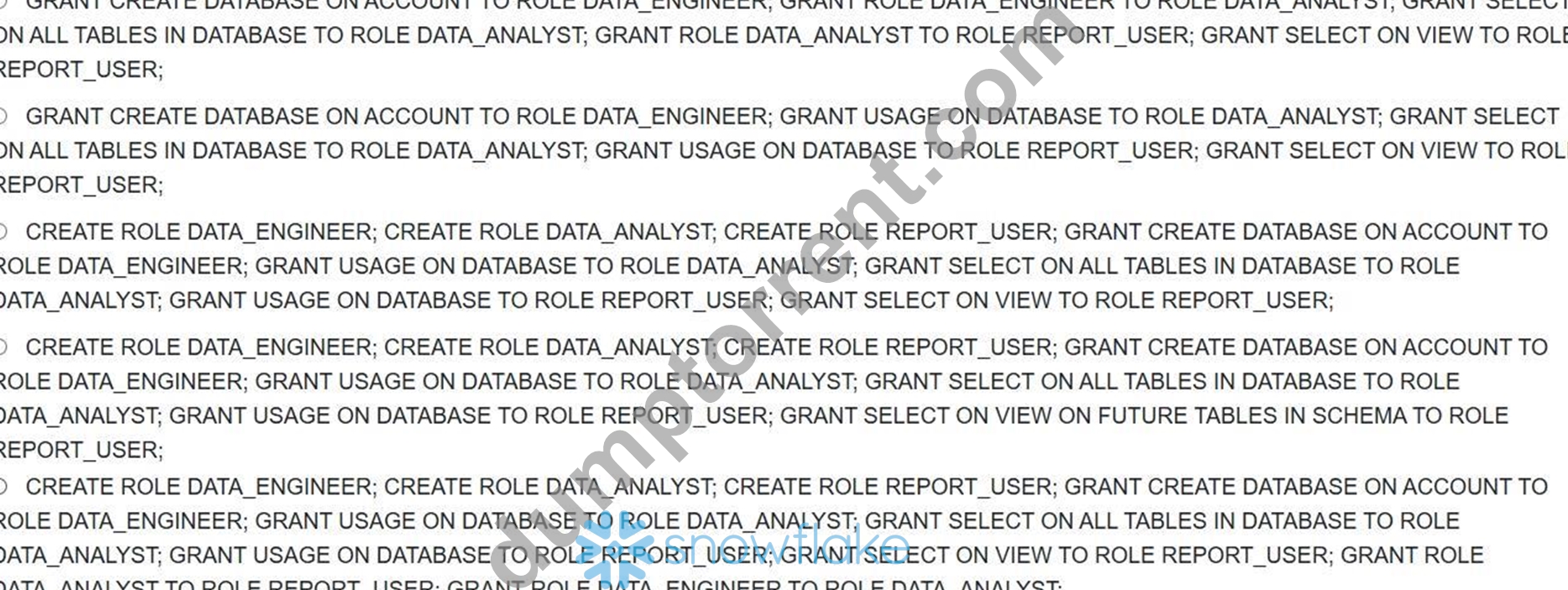
- A. Option B
- B. Option A
- C. Option E
- D. Option D
- E. Option C
Answer: C
Explanation:
Option E is the most complete answer. It creates the roles, grants necessary database creation privileges to DATA_ENGINEER, allows DATA ANALYST to use and query the database, and REPORT USER to use the database and select from the specified view. The role grants establish the hierarchy. Options A and B have incorrect grant statements for select on all tables in the database and lack the creation of Roles at the begining. Option D does not grant the roles to each other, leaving the hierarchy incomplete, and incorrectly attempts to grant select on future tables directly to a view.
NEW QUESTION # 69
A user is trying to transfer ownership of a view from role `role_a' to The user executes the following command: ALTER VIEW employee_view TRANSFER OWNERSHIP TO ROLE role_b; The command fails with an error indicating insufficient privileges. Which of the following could be the reason(s) for the failure? (Select all that apply)
- A. The role `role_b' already owns the `employee_view' .
- B. The user does not have the OWNERSHIP privilege on the `employee_view' .
- C. The user does not have the MANAGE GRANTS privilege on the schema containing the
`employee_view' . - D. The user does not have the USAGE privilege on the database containing the `employee_view'.
- E. The role `role b' does not exist.
Answer: B,C
Explanation:
To transfer ownership, the user executing the command must have the OWNERSHIP privilege on the object and the MANAGE GRANTS privilege on the schema containing the object. If does not exist, or already owns the object, a different error would be raised. While USAGE on the database might be required for other operations, it is not a direct requirement for transferring ownership if the user has OWNERSHIP and MANAGE GRANTS.
NEW QUESTION # 70
A Snowflake administrator needs to determine the default collation setting for a newly created database. Which of the following methods can be used to identify the default collation of the database named 'MY DATABASE?
- A. DESCRIBE DATABASE MY DATABASE;
- B. SHOW DATABASES LIKE 'MY DATABASE';
- C. SELECT FROM WHERE option_name = 'COLLATION';
- D. SELECT followed by SELECT collation FROM INFORMATION_SCHEMA.DATABASES WHERE database_name =
- E. SELECT DATABASE COLLATION FROM INFORMATION SCHEMA.DATABASES WHERE
DATABASE NAME = 'MY DATABASE';
Answer: A
Explanation:
'DESCRIBE DATABASE MY_DATABASE;' will show all properties of the database, including the default collation. 'SHOW DATABASES LIKE 'MY DATABASE';' will also show information about the database but does not guarantee displaying the default collation. Options C, D, and E use the INFORMATION_SCHEMA, which is useful, but option A gives direct and complete metadata.
'DATABASE_OPTIONS' table does not exists in information schema. The most efficient method and recommended way is to use `DESCRIBE DATABASE.
NEW QUESTION # 71
You are working with a Snowflake external stage that contains a mix of structured and unstructured data. Specifically, you have a directory in your S3 bucket that contains both CSV files and JSON files. You have enabled directory tables for this stage. You want to create a view that combines data from both the CSV and JSON files. How can you effectively achieve this using the directory table, considering that the CSV and JSON files have different schemas?
- A. Create a single view that uses the 'METADATA$FILENAME column in the directory table to dynamically parse the data based on the file extension (CSV or JSON) using conditional functions within the view definition.
- B. Create two separate views, one for the CSV files and one for the JSON files, using the
'METADATA$FILENAME column in the directory table to filter the files for each view. Then, create a UNION ALL view on top of those views. - C. Create a stored procedure that reads the directory table metadata, determines the file type for each file, and then dynamically creates and executes SQL statements to load the data into a single table.
- D. Create a single external table that automatically detects the file format and schema based on the file extension and loads the data accordingly. Directory tables will then work automatically with this table.
- E. It's not possible to combine data from different file formats (CSV and JSON) directly using directory tables. You need to load the data into separate internal Snowflake tables first.
Answer: B
Explanation:
The most effective approach is to create separate views for each file format (CSV and JSON) and then combine them using a UNION ALL' view. This allows you to handle the different schemas of the CSV and JSON files separately and then present a unified view of the data. Options B and E are more complex and less maintainable. Option C is incorrect because external tables do not automatically detect file formats with mixed data types and schemas. Option D is also incorrect as the directory table can be queried directly with appropriate views.
NEW QUESTION # 72
What is the purpose of assigning roles to users in Snowflake?
- A. To define user tasks
- B. To manage and enforce permissions on objects
- C. To optimize query execution plans
- D. To control which data types users can query
Answer: B
Explanation:
Snowflake uses a Role-Based Access Control (RBAC) model, whererolesare the containers of privileges.
Assigning roles to users ensures that permissions on database objects (such as tables, schemas, warehouses, and functions) are enforced consistently and securely. Users do not receive privileges directly; instead, privileges are granted to roles, and roles are assigned to users.
This enables scalable, auditable, and manageable access control.
Roles do not determine tasks, do not affect query optimization, and do not govern which data types a user may query-permissions are object-based, not datatype-based.
NEW QUESTION # 73
What Snowflake object provides a secure connection to external cloud storage?
- A. A named file format
- B. An external table
- C. An external stage
- D. A directory table
Answer: C
Explanation:
An external stage is the Snowflake object that encapsulates a secure connection to external cloud storage such as Amazon S3, Azure Blob Storage, or Google Cloud Storage. It stores the location (URL or bucket path) and, where required, credentials or role-based access configuration, and may also reference a file format. External stages are used as the source or target for COPY INTO operations when loading from or unloading to external storage.
An external table provides a logical SQL interface to data stored externally but relies on a stage for connectivity; it does not itself define the connection. A directory table exposes metadata about files stored in a stage, not the connection. A named file format defines parsing rules (type, delimiter, compression) but has no knowledge of or connection to a specific external storage location.
NEW QUESTION # 74
You are loading JSON data from an external stage into a Snowflake table called 'events'. The JSON files contain a top-level array of event objects. Some event objects are malformed and cause the 'COPY INTO' command to fail. You need to load as much valid data as possible while logging the errors caused by the malformed objects. Which TWO `COPY INTO' options, when used together, are MOST suitable for achieving this?
- A.

- B.

- C.

- D.

- E.

Answer: C,D
Explanation:
Using ERROR = CONTINUE' allows the COPY command to continue processing files even when encountering errors in individual records. 'VALIDATION_MODE = RETURN_ERRORS' captures the errors encountered during loading, allowing you to log and analyze them without stopping the load process. Skipping the entire file CSKIP_FILE) is less desirable than continuing to load valid data from the file. Purging the files has no effect on the load process or error handling. SON ERROR = ABORT_STATEMENT will abort the whole COPY operation
NEW QUESTION # 75
A financial institution needs to maintain a record of all changes made to its customer data for regulatory compliance. They are using Snowflake and want to leverage Time Travel and Fail-safe for data protection. Which of the following strategies would BEST satisfy this requirement, considering both recoverability and compliance?
- A. Leverage Time Travel within its configured retention period for recovering from user errors or data corruption and understand that Fail-safe is for Snowflake's disaster recovery, not for direct customer use or data retention.
- B. Set to the maximum allowed value (90 days for Business Critical or as configured) and regularly clone the database to a separate, secure location for long-term archival.
- C. Rely solely on Fail-safe for long-term data retention and recovery.
- D. Set to the maximum value for the account. Do nothing else as this will satisfy the audit requirement, because snowflake automatically handles data recovery with continuous backups.
- E. Set appropriately (e.g. 90 days) and regularly back up data to external storage and create granular access roles.
Answer: A,B
Explanation:
Option B provides a comprehensive solution by using Time Travel for the short term within a retention period. After the retention period expires, Fail-safe kicks in (handled by Snowflake). Fail- safe is not directly accessible to the user. A clone is created regularly for archival, providing a long-term record for compliance. Option E accurately describes Fail-safe as a disaster recovery measure rather than a tool for direct data recovery by the customer.
NEW QUESTION # 76
You're using Snowflake Cortex's CLASSIFY TEXT function to analyze customer survey responses. A particular survey question asks respondents to list their favorite features of a product. You want to use CLASSIFY TEXT to categorize the responses, but many responses contain multiple distinct features. How can you best leverage CLASSIFY TEXT to classify each feature mentioned in a single response individually?
- A. Use a Python UDF that leverages an NLP library (e.g., spaCy) to extract individual features from each response, and then apply CLASSIFY TEXT to each extracted feature.
- B. Concatenate all survey responses into a single large string and apply CLASSIFY_TEXT to this combined string. The function will automatically identify and classify individual features within the larger text.
- C. Use a regular expression UDF to split each survey response into individual sentences (assuming each sentence discusses one feature). Then apply CLASSIFY TEXT to each sentence.
- D. Apply CLASSIFY _ TEXT directly to each full survey response. The function is designed to handle multiple features within a single text and return a combined classification.
- E. There is no way to classify multiple features within a single response using CLASSIFY TEXT. The function is designed for single-topic classification only.
Answer: A
Explanation:
Option E is the most effective approach. Using a Python UDF with NLP libraries like spacy allows for accurate extraction of individual features, enabling CLASSIFY TEXT to categorize each one separately. Option A might work in some cases but is unreliable as not all features are discussed in separate sentences. Option B is incorrect because CLASSIFY _ TEXT is meant to classify the sentiment behind the text and not extract features from it. Option C isn't best because the function isn't made to determine multiple classifications for multiple topics. Option D isn't correct because if the features can be extracted, the TEXT_CLASSIFY function can determine categories.
NEW QUESTION # 77
You are working with a Snowflake database that contains sensitive personal data. You need to create a development environment for testing purposes, but you want to ensure that the personal data in the development environment is anonymized while maintaining referential integrity between tables. You have the following tables with foreign key relationships: 'CUSTOMERS' (CustomerlD, FirstName, LastName, Email, Phone) 'ORDERS (OrderlD, CustomerlD, OrderDate, TotalAmount) Which of the following approaches would be the most secure and efficient for creating the anonymized development environment, while still enabling the referential integrity between the tables?
- A. Export the data from the 'CUSTOMERS' and `ORDERS tables to cloud storage, anonymize the personal data during the export process, and then import the anonymized data into new tables in the development environment. Rebuild the table with new 'CustomerlD and then Update
'CustomerlD in the 'ORDERS' table according to new mapping. - B. Clone the `CUSTOMERS and 'ORDERS' tables to the development environment. Create a new
'CUSTOMERS' table where FirstName, LastName, Email and Phone are masked and sequentially numbered 'CustomerlD. Then Update CustomerlD in the 'ORDERS' table according to new mapping - C. Clone the 'CUSTOMERS' and 'ORDERS' tables to the development environment. Create masking policies on the FirstName, LastName, Email, and Phone columns in the `CUSTOMERS table.
Replace the with sequential integers in a new 'CUSTOMERS table and then Update CustomerlD in the 'ORDERS' table according to new mapping. - D. Clone the 'CUSTOMERS and `ORDERS tables to the development environment. Then, manually update the FirstName, LastName, Email, and Phone columns in the `CUSTOMERS' table with dummy values.
- E. Clone the `CUSTOMERS and 'ORDERS' tables to the development environment. Create masking policies on the FirstName, LastName, Email, and Phone columns in the 'CUSTOMERS' table, and also create a sequence to renumber CustomerlD column.
Answer: B
Explanation:
Option D represents the best balance of security, efficiency, and maintainability of referential integrity. Cloning the table and then creating a new table with masked data and sequential numbering will keep `ORDERS' and 'CUSTOMER referentially valid for testing. Options A and C involve manual processes, which are less secure and difficult to scale. Option B doesn't resolve the 'CUSTOMERID' problem when masking is required, but also ensures that it is updated with new sequential values in 'ORDER table, thus not the best answer. Option E relies on the masking of the columns but doesn't address changing the identifying `CUSTOMERID column.
NEW QUESTION # 78
You are developing a Snowflake Notebook to analyze sales data. You need to connect to a Snowflake database using Python and execute a query to retrieve the top 10 products by sales volume. Which of the following code snippets is the MOST efficient and secure way to achieve this, assuming you've already configured the necessary connection details and have
'snowflake.connector' installed?
- A.

- B.

- C.

- D.

- E.

Answer: A
Explanation:
Option E is the most secure and robust. It utilizes environment variables to store credentials securely, includes error handling for potential query execution issues, and ensures that the cursor and connection are closed properly in a `finally' block, even if an error occurs. Option A hardcodes credentials, which is a major security risk. Options B and C don't include comprehensive error handling. Option D uses 'fetchmany(10)' , which might not fetch all results if there are exactly 10 rows and is less common for retrieving all rows.
NEW QUESTION # 79
A Snowflake administrator needs to grant a data analyst the ability to create dashboards and worksheets in Snowsight, but restrict them from modifying existing roles or granting privileges to other users. Which set of privileges is BEST suited for this purpose?
- A. There are no specific privileges required as dashboard and worksheet creation are implicitly granted to all users.
- B. GRANT ALL ON ACCOUNT TO ROLE data_analyst;
- C. GRANT CREATE DASHBOARD ON SCHEMA TO ROLE data_analyst; GRANT CREATE
WORKSHEET ON SCHEMA TO ROLE data_analyst; - D. GRANT CREATE DASHBOARD ON ACCOUNT TO ROLE data_analyst; GRANT CREATE WORKSHEET ON ACCOUNT TO ROLE data_analyst;
- E. GRANT CREATE DASHBOARD ON DATABASE TO ROLE data_analyst; GRANT CREATE WORKSHEET ON DATABASE TO ROLE data_analyst;
Answer: D
Explanation:
Dashboards and worksheets are account-level objects in Snowsight. Therefore, the CREATE DASHBOARD and CREATE WORKSHEET privileges must be granted on the ACCOUNT. Option B and C are incorrect because dashboards and worksheets are not scoped to databases or schemas. Option D grants excessive privileges, violating the principle of least privilege. Option E is incorrect, specific privileges are required.
NEW QUESTION # 80
A data science team needs to access data from several databases and schemas for model training. To simplify access management, you create a custom role, `DATA SCIENCE ROLE.
You need to grant this role the ability to SELECT from all tables in any schema across the following databases: `DB ANALYTICS, 'DB REPORTING'. Which of the following is the MOST efficient approach, minimizing the number of GRANT statements while adhering to least privilege?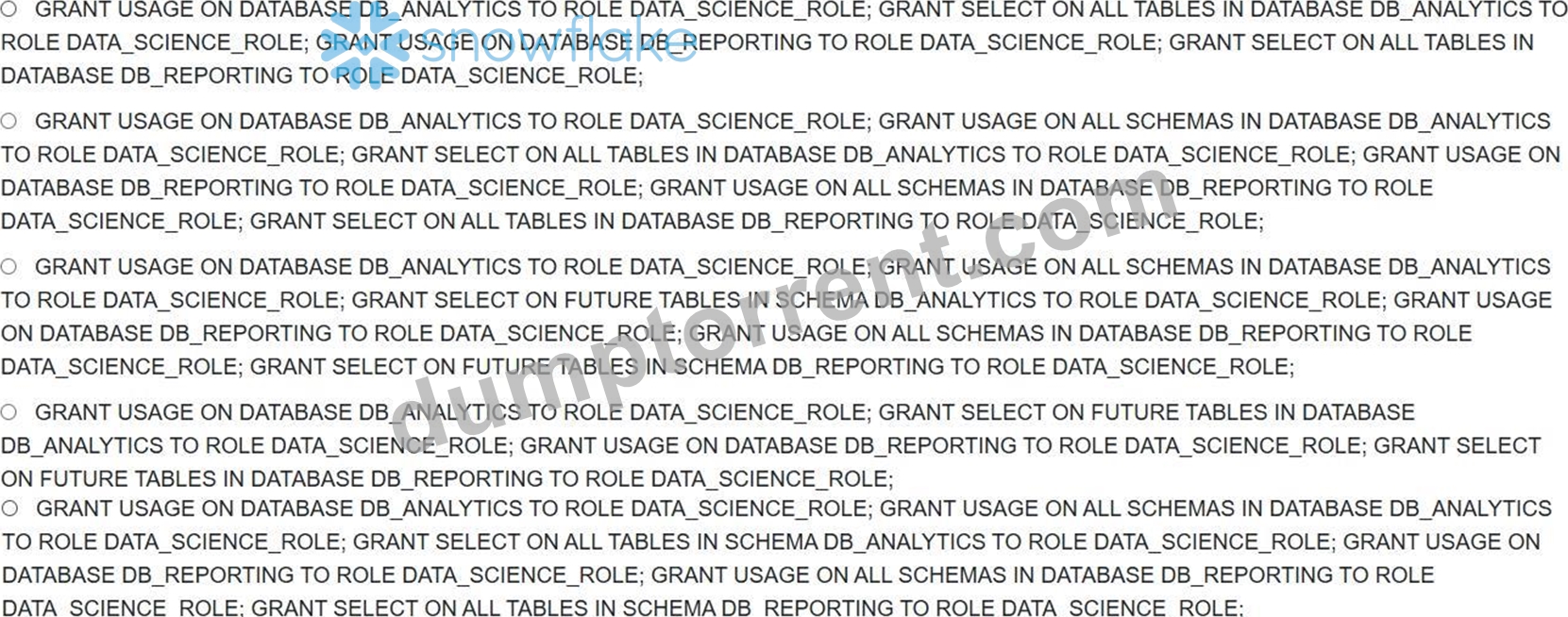
- A. Option B
- B. Option E
- C. Option A
- D. Option D
- E. Option C
Answer: E
Explanation:
Option C is the most efficient. Granting USAGE on the databases is necessary. Granting USAGE on ALL SCHEMAS allows access to existing schemas. 'GRANT SELECT ON FUTURE TABLES IN SCHEMA' is more efficient than granting SELECT on all existing tables and ensures that the role automatically has access to any newly created tables within those schemas.Option A Grants select on ALL tables, but doesn't include future tables. Option B Grants select on ALL tables, but doesn't include future tables and also does not grant USAGE on the SCHEMAS directly. option D Grants select on FUTURE TABLES for the database directly, which is not possible.
NEW QUESTION # 81
You have a Snowflake virtual warehouse named 'ANALYTICS WH' that is used for complex data transformations. You need to ensure that the warehouse automatically suspends itself when it's idle to minimize costs, but also want to ensure it can quickly resume when a query is submitted.
You also want to scale up the warehouse size during peak business hours to handle increased query load. Which of the following actions should you take?
- A. Set 'AUTO SUSPEND = 3600' and 'AUTO RESUME = FALSE on the warehouse. Manually resize the warehouse using the Snowflake web interface as needed.
- B. Set 'AUTO SUSPEND = 60' and 'AUTO RESUME = TRUE on the warehouse. Use Resource Monitors to automatically increase or decrease the warehouse size based on credit consumption during different times of the day.
- C. Set 'AUTO SUSPEND = 300' and 'AUTO RESUME = TRUE on the warehouse. Create a scheduled task using Cron to automatically resize the warehouse using 'ALTER WAREHOUSE based on business hours.
- D. Configure a Resource Monitor with a predefined credit quota and assign it to the `ANALYTICS WY-I' warehouse, allowing it to automatically resize based on the workload.
- E. Set 'AUTO SUSPEND = 60' and 'AUTO RESUME = TRUE on the warehouse. Schedule a task that runs every hour to execute `ALTER WAREHOUSE ANALYTICS_WH SET WAREHOUSE_SIZE = LARGE during peak hours and back to 'SMALC during off-peak hours.
Answer: C
Explanation:
Option D is the most appropriate solution. Setting to a reasonable value (300 seconds = 5 minutes) ensures cost optimization by automatically suspending the warehouse when idle.
Setting 'AUTO_RESUME = TRUE ensures the warehouse resumes automatically when a query is submitted. Using a scheduled task with SALTER WAREHOUSE' provides programmatic control to resize the warehouse during peak hours. A is mostly correct but uses resource monitor to handle increasing and decreasing the warehouse size, using Scheduled Tasks to do this is more appropriate. B has `AUTO RESUME = FALSE', which is undesirable. C is incorrect since resource monitors cannot increase/decrease warehouse size. E while related to cost management, resource monitors themselves don't handle warehouse resizing dynamically based on workload. Using a task for this with 'ALTER WAREHOUSE provides explicit control.
NEW QUESTION # 82
You are tasked with loading data from a set of CSV files located in an Amazon S3 bucket into a Snowflake table named 'CUSTOMER DATA'. The files have headers, but some files might have inconsistent column order compared to the table schema. The table 'CUSTOMER DATA' is already created with the correct schema. Which of the following COPY INTO command options is BEST suited to handle this situation efficiently, minimizing manual intervention and ensuring all relevant data is loaded?
- A. Use along with 'ON_ERROR = CONTINUE in the COPY INTO statement. Define a file format object with = 1' and reference this object in the COPY INTO statement.
- B. Use 'ORDER BY clause in the 'COPY INTO' statement to explicitly define the order of columns from CSV files to target table columns.
- C. Create a view on top of the staged data using 'SELECT statements that explicitly map columns by name to the 'CUSTOMER DATA' table. Then, 'INSERT data from the view into the table.
- D. Define a file format object with `SKIP_HEADER = 1' and -- (if applicable). Use 'MATCH BY COLUMN NAME-CASE INSENSITIVE along with 'ON_ERROR = SKIP FILE in the COPY INTO statement. Use 'VALIDATE function to check the staging file first before actual loading.
- E. Use a simple 'COPY INTO' statement without any specific options and rely on Snowflake's automatic column matching. If errors occur, manually adjust the files and reload.
Answer: A
Explanation:
Ensures that columns are matched by name regardless of case, handling inconsistent column order. ERROR = CONTINUE' allows loading to proceed even if some rows have errors, and
`SKIP HEADER = in file format skips the headers. Using a view adds an unnecessary step and overhead. 'ORDER_BY is not relevant for controlling the order of columns being loaded. While
`VALIDATE' is useful for pre-loading checks, can lead to data loss if a single row error exists in the whole file. 'ON ERROR=CONTINUE along with monitoring the error logs offers a more controlled loading process.
NEW QUESTION # 83
A data warehouse contains a table 'ORDERS' with columns 'ORDER ID', 'CUSTOMER ID',
'ORDER DATE, and `ORDER TOTAL' You need to optimize a query that frequently retrieves the total order amount for a specific customer within a given date range. Which of the following strategies would be MOST effective in improving query performance?
- A. Cluster the `ORDERS' table using `CUSTOMER ID and `ORDER DATES.
- B. create an index on the 'ORDER DATE column.
- C. Increase the warehouse size to allow for more compute resources.
- D. Create a view that filters the `ORDERS' table based on the date range.
- E. Create a materialized view that pre-calculates the total order amount for each customer.
Answer: A
Explanation:
Clustering the table on `CUSTOMER ID and 'ORDER DATE is the most effective strategy because it physically organizes the data on disk based on these columns. This allows Snowflake to efficiently retrieve the relevant data for a specific customer and date range, minimizing the amount of data that needs to be scanned. Increasing warehouse size will improve general performance, but clustering optimizes for this specific query. Indexes are not typically used in Snowflake. A materialized view would be good, however, clustering is more effective.
NEW QUESTION # 84
What is a key benefit of using Streamlit for data visualization in Snowflake notebooks?
- A. Simplified code execution
- B. Manual data storage
- C. Fixed-size compute clusters
- D. Real-time interactivity and dynamic visualizations
Answer: D
Explanation:
Streamlit inside Snowflake Notebooks enables users to buildinteractive, real-time visualizations and data applicationsdirectly within Snowsight. Because Streamlit is event-driven, users can create UI components such as sliders, dropdowns, date pickers, buttons, and filters that dynamically update charts, tables, and computed outputs.
Data remains inside Snowflake, processed through Python with Snowpark, eliminating data movement to external systems. This allows rapid prototyping of dashboards, analytical workflows, and AI-driven apps.
Streamlit also supports layout customization, reactive components, and seamless integration with Snowflake compute for scalable analytics.
Incorrect options:
* Streamlit doesnotmanage data storage.
* Streamlit does not simplify code execution; it enhances visualization and interactivity.
* Warehouse clusters are not fixed-size-Snowflake warehouses can scale.
Thus, its primary benefit is enablingrich interactive analytics directly within Snowflake.
NEW QUESTION # 85
A data engineer needs to load JSON files containing customer reviews stored in an external stage 's3://my-bucket/reviews/'. The JSON structure varies significantly between files, but the goal is to extract 'review_id', 'customer_id', and 'review text' into a Snowflake table 'CUSTOMER REVIEWS'. The engineer is using a COPY INTO statement with a transform. Which of the following is the MOST efficient and correct way to achieve this?
- A. Use a COPY INTO statement with a JSON path expression to extract the required fields during the load. If a field is missing, handle it with 'NULLIF or similar functions during the COPY INTO.
- B. Create a custom file format that defines the expected JSON structure, even though it varies, and rely on Snowflake to handle the variations during the COPY INTO operation.
- C. Write a Python UDF to parse the JSON, extract the required fields, and then use the UDF in a COPY INTO statement.
- D. Use a VARIANT column in 'CUSTOMER_REVIEWS' and load the entire JSON structure. Then, use SQL to extract the required fields during querying.
- E. Create separate tables for each JSON structure variation and then use a UNION ALL view to combine the data.
Answer: A
Explanation:
Option C is the most efficient. Using a JSON path expression in the COPY INTO statement allows extracting the desired fields directly during the load, avoiding the need to load the entire JSON and then process it. 'NULLIF or similar functions can be used to handle cases where a field might be missing in some JSON documents. Options A, B, D, and E are less efficient or impractical. Loading the entire JSON (A) requires post-processing. Creating separate tables (B) is complex and doesn't scale well. Python UDF (D) introduces overhead and performance limitations. Relying on a custom format without explicitly handling variations (E) will lead to errors.
NEW QUESTION # 86
What information can be accessed using the Snowsight Monitoring tab?
- A. Database Time Travel snapshots
- B. Database schema changes history
- C. Virtual warehouse usage metrics
- D. Query execution history
Answer: C
Explanation:
The Snowsight Monitoring tab provides a centralized view of virtual warehouse usage metrics, enabling administrators and developers to evaluate how compute resources are being consumed. This includes critical insights such as credit usage, query load, concurrency levels, average queue times, execution durations, and auto-scaling activity (for multi-cluster warehouses). These metrics help determine whether a warehouse is correctly sized, whether concurrency issues are occurring, or whether workloads require scaling up or adding clusters.
Query history is available in a different section-"Activity # Query History"-not under Monitoring. Time Travel snapshots are not visualized within Monitoring; Time Travel is controlled via retention parameters and accessed with SQL (AT/BEFORE clauses). Schema change history is also not part of Monitoring and instead is discoverable through ACCOUNT_USAGE or specific metadata views.
The Monitoring tab exists specifically to help evaluate warehouse performance and resource consumption, enabling optimization of compute spending and better workload management.
NEW QUESTION # 87
Which of the following are examples of unstructured data? (Choose any 3 options)
- A. JSON
- B. Pdf
- C. Video
- D. Image
Answer: B,C,D
Explanation:
Unstructured data refers to content that lacks a predefined schema or consistent structural pattern. It cannot be represented naturally in tabular or hierarchical formats without extraction or transformation. Snowflake supports unstructured data through external tables and native features allowing storage and machine learning analyses.Images,videos, andPDFsfall into this category because they contain raw multimedia or document content without intrinsic row/column structure, often requiring OCR, video/audio processing, or content extraction. In contrast, JSON is semi-structured, containing keys, hierarchical structures, and metadata that Snowflake's VARIANT type can interpret directly. Unstructured data is becoming increasingly important for AI-driven workloads, enabling use cases such as OCR with PARSE_DOCUMENT, deep-learning analysis of images and video, and document intelligence tasks.
NEW QUESTION # 88
A large e-commerce company is experiencing seasonal spikes in sales traffic, leading to significant increases in data ingestion and query processing. You are tasked with optimizing their Snowflake environment. Which of the following strategies BEST leverage Snowflake's elastic storage and compute capabilities to handle these fluctuating workloads efficiently and cost- effectively?
- A. Utilize Snowflake's auto-scaling feature for virtual warehouses to automatically adjust compute resources based on real-time demand, coupled with setting resource monitors to control spending.
- B. Rely solely on Snowflake's automatic storage scaling and ignore the virtual warehouse size, as storage is the primary bottleneck during peak seasons.
- C. Use only the X-Small virtual warehouse size, since Snowflake's cloud-based architecture distributes processing across nodes automatically without needing larger warehouses.
- D. Pre-process all incoming data into smaller, aggregated tables before loading it into Snowflake to reduce the storage footprint.
- E. Manually resize the Snowflake virtual warehouse based on anticipated peak loads at the beginning of each season and reduce it back down after the peak ends.
Answer: A
Explanation:
Option B is the most effective strategy. Snowflake's auto-scaling feature automatically adjusts compute resources to match demand, ensuring optimal performance during peak periods.
Resource monitors prevent runaway costs. Option A is less efficient as it relies on manual intervention and might not react quickly enough to changing demands. Option C neglects the importance of compute scaling. Option D introduces unnecessary complexity and potential data loss. Option E will lead to poor performance during peak loads.
NEW QUESTION # 89
A Snowflake account has multiple custom roles, including `DATA ADMIN', 'ANALYST , and
'REPORTING'. The `DATA ADMIN role should be able to grant all privileges on any object in the
'SALES' database to other roles. Which of the following approaches is the MOST secure and efficient way to achieve this?
- A. Grant the 'ALL PRIVILEGES' on the 'SALES' database and all its objects to the `DATA_ADMIN' role.
- B. Create a custom role hierarchy where 'DATA_ADMIN' inherits all privileges from the
'ACCOUNTADMIN' role. - C. Grant the 'OWNERSHIP privilege on the ` SALES' database to the 'DATA_ADMIN' role. Then, set as the owner of all objects within the database.
- D. Grant USAGE on the 'SALES' database to the 'DATA ADMIN' role and manually grant all other individual privileges as needed to the `DATA ADMIN' role.
- E. Grant the OWNERSHIP privilege on the SALES database to the DATA ADMIN role. When an object is created the DATA ADMIN must take ownership of the newly created object.
Answer: C
Explanation:
Granting the `OWNERSHIP' privilege on the database allows the 'DATA_ADMIN' role to grant all privileges on the database and all its objects to other roles. Option B, granting 'ALL PRIVILEGES' , does not automatically propagate the ability to grant those privileges to other roles. Option C is inefficient. Option D is incorrect; custom roles cannot inherit directly from
`ACCOUNTADMIN'. Option E is partially correct, but missing the critical step of initially granting OWNERSHIP on the database itself.
NEW QUESTION # 90
When unloading data from a Snowflake table, what is the target destination for the COPY INTO @stage command?
- A. An internal or external stage
- B. A data stream
- C. A local file system
- D. Another Snowflake table
Answer: A
Explanation:
COPY INTO @stage writes query results or table data into files stored in either internal or external stages.
Unloading cannot target a local filesystem directly, cannot load into another table (use INSERT instead), and does not write to streams.
NEW QUESTION # 91
A data engineer needs to create a new external stage in Snowflake to access data stored in AWS S3. The S3 bucket is encrypted using AWS KMS. Which of the following SQL commands is the MOST SECURE and complete way to create the stage, assuming the necessary IAM role and key ARN are already known and have the appropriate Snowflake permissions?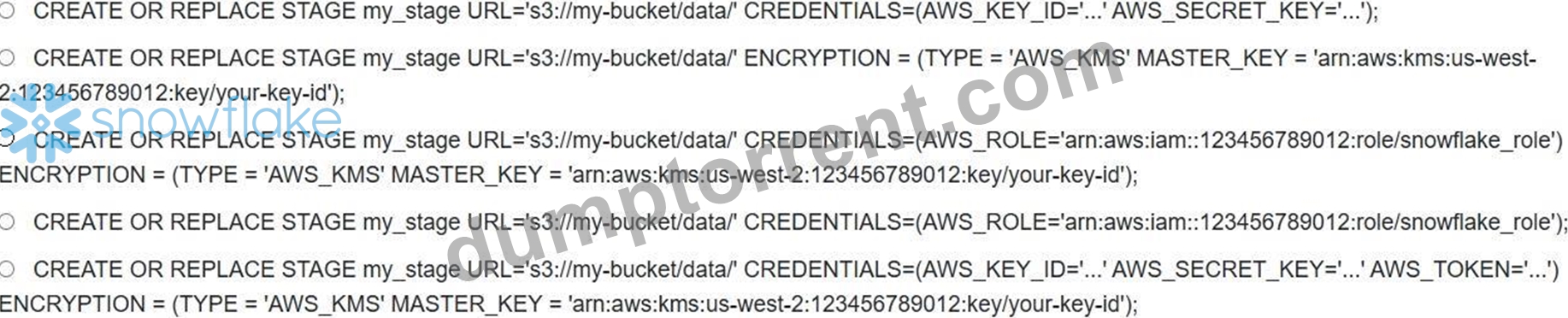
- A. Option B
- B. Option A
- C. Option D
- D. Option C
Answer: D
Explanation:
Option C is the most secure because it uses an IAM role for authentication, which avoids storing long- term AWS keys directly in Snowflake. It also specifies the KMS encryption, which is necessary for accessing data encrypted with KMS. Option A uses AWS Keys, which is less secure. Option B doesn't provide the credentials. Option D only provides credentials with IAM role but not ENCRYPTION parameter for KMS encryption. Option E uses AWS Keys along with a token, which is still less secure than using an IAM role for authentication.
NEW QUESTION # 92
......
Authentic Best resources for SOL-C01 Online Practice Exam: https://pass4sure.dumptorrent.com/SOL-C01-braindumps-torrent.html