


[Jun 13, 2026] Get to the Top with L4M7 Practice Exam Questions
Use Real L4M7 Dumps Free Sample Questions and Practice Test Engine
CIPS L4M7 exam covers a wide range of topics related to whole life asset management, such as the identification, acquisition, development, utilization, and disposal of assets. L4M7 exam is specifically designed to help professionals develop knowledge and skills that are required to manage the complete lifecycle of assets effectively. The CIPS L4M7 certification includes practical skills in monitoring, maintenance, and optimization of assets, focusing on sustainability, risk management, and governance.
CIPS L4M7 Certification Exam is a highly respected and recognized certification in the field of asset management. CIPS Whole Life Asset Management certification is recognized globally and is a testament to the holder's knowledge and expertise in asset management. CIPS Whole Life Asset Management certification is highly valued by employers and can enhance career prospects for professionals in the field.
NEW QUESTION # 105
ASI Ltd is known for its commitment to sustainability. ASI builds railroad ties and pilings using recycled plastic bottles and industrial waste instead of standard materials such as wood, steel, and cement. This practice helps the company save 15% in compare with traditional material purchases. Which pillar of sustainability would include the practice of ASI Ltd?
- A. Planet and Profit
- B. Profit and Expense
- C. Profit and People
- D. People and Planet
Answer: A
Explanation:
The triple bottom line is a sustainability framework that examines a company's social, environment, and economic impact (or People, Planet, Profit). ASI Ltd practice would reduce the waste into the environment as well as keep the business more profitable. So the correct answer should be Planet and Profit.
Reference:
- 25 Years Ago I Coined the Phrase "Triple Bottom Line." Here's Why It's Time to Rethink It.
- CIPS study guide page 202
LO 3, AC 3.3
NEW QUESTION # 106
A logistics company has a 2-story warehouse in the suburban area. The goods receiving area and dispatch area are located on the ground floor only. There is a lift connecting the two floors. The daily operations of the warehouse are quite busy. Which of the following would the best arrangement for this warehouse?
- A. Medium- to low-usage palletised items will be stored on the ground floor, high-usage items will be stored on the first floor where the building administrative office is located
- B. Small items in tote boxes will be stored on the ground floor with forklifts and other equipment, high- usage palletised items will be stored on the first floor
- C. Forklifts and other warehouse equipment will park on the ground floor, all inventories will be stored on the first floor
- D. Pallets, roller cages and other bulky items will be stored on the ground floor, smaller items in plastic tote boxes will be stored on the first floor
Answer: D
Explanation:
The purposes of a warehouse are to keep the inventories in good condition and to ensure that the operations is smooth. In the scenario, the warehouse has 2 stories, with goods-in and goods-out areas located on the ground floor and a lift connecting the stories. The lift could become a bottleneck if the goods inside the warehouse are not well-arranged.
Since the lift is often small with limited load capacity, putting heavy bulk items on the first floor will cause bottleneck and increase the chance of accidents. Therefore, palletised items (even they have low-usage) should be placed on the ground floor. Smaller and lighter items should be stored on the first floor.
This questions does appear in the real exam. To answer the question, students should imagine the situation.
Reference: CIPS study guide page 11-13
LO 1, AC 1.1
NEW QUESTION # 107
An organisation may incur additional costs in stockout events. Which of the following is an exam-ple of costs of inventory stockouts?
- A. The lost contribution margin on sales forgone as a result of customer dissatisfaction due to unavailability of goods
- B. The costs of storage space owned that cannot be used for other profitable purposes when inventories decrease
- C. The return forgone by investing capital in inventory rather than elsewhere
- D. The costs of obsolescence and costs of insurance that change with the quantity of in-ventory held
Answer: A
Explanation:
Stockout is a situation where an inventory item is not available when required. The costs associated with a stockout include the following:
- Lost of production output - there will be no production until the stockout is resolved (new stock is acquired).
For factory operating 24/7 with no spare capacity, this lost output will not be able to be recovered.
- Costs of machine downtime and of overhead spread over a reduced level of output
- Costs of any action required to deal with the stockout...
- Loss of customer goodwill through inability to supply or late delivery
- Loss of sales or new orders
- Loss of market creditability
NEW QUESTION # 108
A retailer wants to improve its service level in inventory management from 95% to 97%. Which of the following is the best course of action?
- A. Expanding replenishment lead time
- B. Decreasing safety stock
- C. Increasing safety stock
- D. Holding more cycle stock
Answer: B
Explanation:
For single items, an extra investment in inventory (higher levels of safety stock) will always in-crease customer service levels. Conversely, higher service levels imply larger quantities of safety stocks and an increased investment in inventory. (Procurement and Supply Chain Management - 9th Edition) Reference: CIPS study guide page 104-105 LO 2, AC 2.2
NEW QUESTION # 109
XYZ Ltd is looking for new office space overseas. To keep the overhead expense minimal, it chooses leasing rather than purchasing new office. In leasing contract, which of the following costs are most likely to be attributable to the lessee?
1. Disposal costs
2. Rentals
3. Operating costs
4. Vendor selection costs
- A. 2, 3 and 4
- B. 1, 2 and 4
- C. 1, 3 and 4
- D. 1, 2 and 3
Answer: A
Explanation:
A lease is a contractual arrangement calling for the lessee (user) to pay the lessor (owner) for use of an asset.
Property, buildings and vehicles are common assets that are leased. Industrial or business equipment is also leased. Since the lessee does not own the asset, it is not responsible for disposing the assets, and therefore, disposal costs are not attributable to the lessee. The lessee usually incurs rentals and operating costs. Finally, a company should treat the lease the same as other contracts, which they must qualify the supplier.
Reference: CIPS study guide page 144-147
LO 3, AC 3.1
NEW QUESTION # 110
A piece of machinery has reached the end of its manufacturing life cycle and is due to be disposed of. What is the process that must take place for this to occur?
- A. Decommissioning
- B. Whole-life costing
- C. Inventory management
- D. Commissioning
Answer: A
Explanation:
Decommissioning is the process of safely retiring equipment from use. It involves steps such as cleaning, dismantling, and responsibly disposing of the asset, especially if it contains hazardous materials. Whole-life asset management includes decommissioning as a key phase, ensuring that assets are disposed of cost- effectively and in compliance with environmental standards.
NEW QUESTION # 111
In the periodic review system, the order quantity is the same for each order. Is this statement true?
- A. No, the inventory position at each review point differs from each other
- B. No, the next order quantity must be larger than the previous one
- C. Yes, the order quantity should be equal to economic order quantity
- D. Yes, in periodic review system items are reviewed when the Kanban is triggered
Answer: A
Explanation:
Fixed-Time Period System (or Periodic Review system) is the inventory management system in which inventory is checked in fixed time periods, T, and the quantity ordered varies. The system also contains a target inventory level, R, which is restored when order received. The order quantity is calculated as:
Q = R - IP
where: Q = order quantity
R = target inventory level
IP = inventory position
Inventory position (IP) is equal to inventory on-hand plus quantity on order minus backorder (if any) The order quantity varies because the inventory position at each review point differs from each other.
Diagram Description automatically generated with medium confidence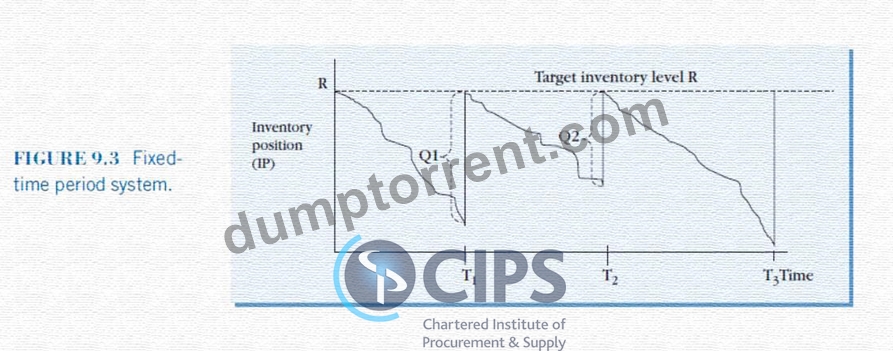
LO 2, AC 2.3
NEW QUESTION # 112
For which of the following is the 'delphi method' used?
- A. Valuing stock
- B. Classifying products
- C. Controlling products
- D. Forecasting demand
Answer: D
Explanation:
Delphi method is a structured forecasting technique using a panel of experts and a number of rounds of questioning. Responses are shared after each round and the experts encouraged to recon-sider their own responses. It is intended to achieve a consensus view.
Reference:
LO 2, AC 2.3
NEW QUESTION # 113
Which of the following is the Japanese word for 'billboard' or 'signboard'?
- A. Kaizen
- B. Muda
- C. Poka-Yoke
- D. Kanban
Answer: D
Explanation:
Kanban (看板) (signboard or billboard in Japanese) is a scheduling system for lean manufacturing and just-in-time manufacturing (JIT).
Poka-yoke (ポカヨケ, [poka yoke]) is a Japanese term that means "mistake-proofing" or "inadvertent error prevention". A poka-yoke is any mechanism in any process that helps an equipment operator avoid (yokeru) mistakes (poka). Its purpose is to eliminate product defects by preventing, correcting, or drawing attention to human errors as they occur.
Kaizen is a concept referring to business activities that continuously improve all functions and involve all employees from the CEO to the assembly line workers. Kaizen (改善) is the Sino-Japanese word for "improvement". Kaizen also applies to processes, such as purchasing and logis-tics, that cross organizational boundaries into the supply chain.
Muda (無駄, on'yomi reading) is a Japanese word meaning "futility; uselessness; wastefulness", and is a key concept in lean process thinking, like the Toyota Production System (TPS) as one of the three types of deviation from optimal allocation of resources (the others being mura and muri). Waste reduction is an effective way to increase profitability.
Reference:
LO 2, AC 2.3
NEW QUESTION # 114
A supplier delivers large quantities of inventory to its customer's store, but only charges for the goods as and when they are used. This can be described as...?
- A. Multi-echelon stock
- B. Components inventory
- C. Consignment stock
- D. Multi-stage inventory
Answer: C
Explanation:
Consignment stock is stock legally owned by one party, but held by another, meaning that the risk and rewards regarding to the said stock remains with the first party while the second party is re-sponsible for distribution or retail operations. Ownership of consignment stock is passed only when the stock is used (issued or sold in the case of a shop). Unused stock in a warehouse may be returned to the supplier when it concerns standard manufactured products. With customer specific items, agreements concerning returning products, should be negotiated.
Reference: CIPS study guide page 31
LO 1, AC 1.1
NEW QUESTION # 115
Which of the following is the most suitable container of fasteners (screws, nails, nuts and bolts,...)?
- A. Pallet
- B. Stock cage
- C. Tote box
- D. Bar rack
Answer: C
Explanation:
Tote box is the reusable storage box. These can be open or have lids or flaps to close them and come in a large variety of sizes and weight loadings.
A tote is ideal for holding and hauling items such as: tools, fasteners, bark dust, dry cement, cords, wires, smaller boxes,...
Pallets are the platform structures designed to support a load and be lifted using the forks (typically seen on forklift trucks and other equipment). These are in a variety of standard sizes and can be made of many materials including plastics, resin, board or timber. Pallets are not containers, but support platforms.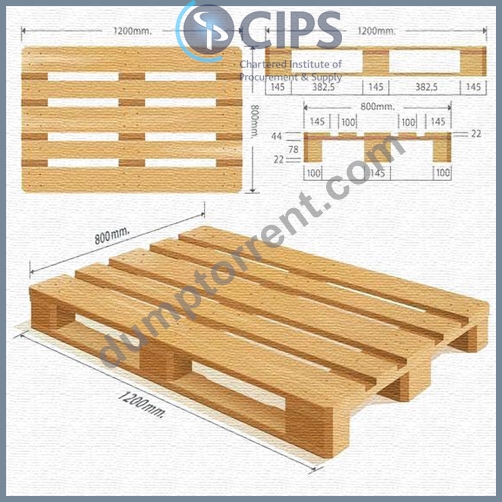
Bar racks are designed to store bars and pipes
Stock cages are available in many sizes and can hold single items or groups of items
NEW QUESTION # 116
The minimal total cost is always achieved when there is only one warehouse. Is this statement true?
- A. No, fewer warehouse may lead to increasing transport costs
- B. Yes, because the operation cost for warehouse reaches minimal level
- C. No, more warehouses will reduce the cost of storage
- D. Yes, because warehouse overheads are fully utilised
Answer: A
Explanation:
The total cost of storage consists of two different costs:
- The cost of warehouses: each one has a different cost, and each has the cost of stock-holding and stock management included
- The transport costs: the total transport cost reduces as further warehouses mean shorter final delivery to the customers.
Depending on each situation, the optimal number of warehouses varies. Generally, more facilities will increase the cost of warehouses while reduce the transport costs and vice versa.
NEW QUESTION # 117
In ABC analysis, category C is also known as...?
- A. Indirect spend
- B. Direct spend
- C. Long tail spend
- D. Capital expense
Answer: C
Explanation:
Tail Spend is derived from ABC Analysis, Class A high value suppliers, Tail Spend is formed from class B & C suppliers, equates to 20% of the total spend, B is Mid Tail and C is Long tail. Effective Spend Analysis and tail spend management, ensures that procurement can focus on creating an optimum and efficient sourcing strategy.
Procurement Spend Analysis
Procurement organisations effectively identify and manage suppliers using a sourcing strategy. Tail suppliers normally have low strategic value and makes the category management, very difficult . Spend Analysis and Category Management are very closely aligned, Spend Analysis including ABC, provides the category manager, with spend visibility.
Spend Analysis and procurement metrics are used to create category plans, build supplier relation-ships, to maintain service levels and deliver the best possible price and quality for goods and ser-vices bought. The acquisition of Spend data and subsequent Spend Analysis, provides Category Managers access to a well-structured procurement process, Reference:
LO 2, AC 2.1
NEW QUESTION # 118
Buffer stock is a level of stock which ...
- A. is the maximum stock in inventory
- B. is half of the actual stock that needs to be in the warehouse
- C. is the minimum stock level below which actual stock should not fall
- D. is when the physical ordering process should start to replenish used items
Answer: C
Explanation:
Buffer stock serves as a safety net to prevent stockouts by ensuring that a minimum stock level is always maintained. This strategy is essential in whole-life asset management to manage demand fluctuations and minimize the risk of supply chain disruptions.
NEW QUESTION # 119
Which of the following costs does the EOQ minimise?
- A. Total cost of safety stock
- B. Total cost of carrying stock
- C. Total cost of ordering inventory
- D. Total cost of annual inventory cost
Answer: D
Explanation:
Economic order quantity (EOQ) was developed in 1913 by Ford W. Harris and has been refined over time.
The formula assumes that demand, ordering, and holding costs all remain constant. The EOQ minimizes the total annual inventory cost.
EOQ formula is as follow: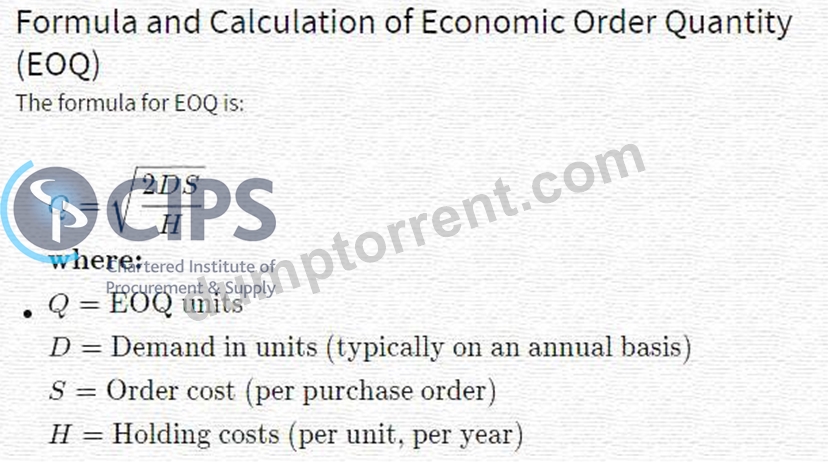
LO 2, AC 2.3
NEW QUESTION # 120
A warehouse manager is evaluating the use of Automated Guided Vehicles (AGVs) within a repetitive task environment. After reviewing their use and price, the manager decided to invest in several AGVs. Were they correct in doing this?
- A. No, as it reduces the flexibility of the warehouse operations
- B. Yes, organisations must use high-tech solutions where possible
- C. No, as they are only suitable for use in non-repetitive task environments
- D. Yes, as it will reduce the costs of employing labour
Answer: D
NEW QUESTION # 121
Which of the following correctly describes the triple bottom line?
- A. People, Planet, Profit
- B. People, Planet, Project
- C. People, Product, Profit
- D. Professional, Planet, Profit
Answer: A
Explanation:
The triple bottom line is a sustainability framework that examines a company's social, environment, and economic impact (or People, Planet, Profit).
Reference:
- 25 Years Ago I Coined the Phrase "Triple Bottom Line." Here's Why It's Time to Rethink It.
- CIPS study guide page 202
LO 3, AC 3.3
NEW QUESTION # 122
Toll Group has thousands of end-of-life IT assets that need to be disposed of. The senior manage-ment of Toll Group is largely concerned about sustainability in waste management, especially electronicwaste. Before selecting a supplier to manage the process, the procurement team is required to assess the environmental risks regarding disposal of the assets. Risk assessment is basically based on the measurement of which factors?
1. Impact
2. Reward
3. Surveillance
4. Likelihood
- A. 2 and 3 only
- B. 1 and 4 only
- C. 1 and 3 only
- D. 2 and 4 only
Answer: B
Explanation:
All risk management processes follow the same basic steps, although sometimes different jargon is used to describe these steps. Together these 5 risk management process steps combine to deliver a simple and effective risk management process.
Step 1: Identify the Risk. You and your team uncover, recognize and describe risks that might affect your project or its outcomes. There are a number of techniques you can use to find project risks. During this step you start to prepare your Project Risk Register.
Step 2: Analyze the risk. Once risks are identified you determine the likelihood and consequence of each risk.
You develop an understanding of the nature of the risk and its potential to affect pro-ject goals and objectives.
This information is also input to your Project Risk Register.
Step 3: Evaluate or Rank the Risk. You evaluate or rank the risk by determining the risk magni-tude, which is the combination of likelihood and consequence. You make decisions about whether the risk is acceptable or whether it is serious enough to warrant treatment. These risk rankings are also added to your Project Risk Register.
Step 4: Treat the Risk. This is also referred to as Risk Response Planning. During this step you assess your highest ranked risks and set out a plan to treat or modify these risks to achieve acceptable risk levels. How can you minimize the probability of the negative risks as well as enhancing the opportunities? You create risk mitigation strategies, preventive plans and contingency plans in this step. And you add the risk treatment measures for the highest ranking or most serious risks to your Project Risk Register.
Step 5: Monitor and Review the risk. This is the step where you take your Project Risk Register and use it to monitor, track and review risks.
NEW QUESTION # 123
Which of the following would be an impact of low stock in the supply chain?
* Warehouse space would all be full with excess stock
* There may be delays and higher costs to fulfill supply
* Stock may not be available at times of high demand
* Lead times would reduce and purchase costs would fall
- A. 1 and 4 only
- B. 2 and 3 only
- C. 1 and 3 only
- D. 2 and 4 only
Answer: B
Explanation:
Low stock levels can lead to:
* Delays and higher fulfillment costs: When stock is insufficient, emergency orders and expedited shipping may be necessary, increasing costs.
* Stockouts during high demand: Insufficient inventory can lead to missed sales opportunities, negatively impacting customer satisfaction.
Whole-life asset management seeks to balance inventory levels to avoid stockouts while minimizing holding costs.
NEW QUESTION # 124
SpeedyCar GmbH is a vehicle manufacturer that is launching a new electric vehicle onto the market, replacing a previous diesel vehicle. There is a lot of equipment in the manufacturing site to be changed, some new machinery to replace older machinery, and some production equipment to decommission. The costs of decommissioning would include which of the following?
- A. Costs to upgrade electric vehicle charging facilities
- B. Sales and marketing costs of the new electric vehicle
- C. Engineering drawing fees for the new electric vehicle designs
- D. Decontamination and cleaning costs for site areas
Answer: D
NEW QUESTION # 125
"A measure of the ability of an organisation to supply customers without delay" is the best defini-tion of which of the following:
- A. Service level
- B. Key performance indicator
- C. Re-order level
- D. Safety stock
Answer: A
Explanation:
In inventory management, service level is the expected probability of not hitting a stock-out during the next replenishment cycle or the probability of not losing sales.
Key performance indicators (KPIs) can be used to analyse data based on performance objectives and set actionable goals for improvement. KPIs can be developed in conjunction with suppliers as well as others, and can be used to measure the essential elements of the process.
Safety stock is the amount of inventory a business needs to have to achieve a certain level of risk mitigation when it comes to stockouts.
Reorder level (or reorder point) is the inventory level at which a company would place a new order or start a new manufacturing run.
Reference:
LO 2, AC 2.3
NEW QUESTION # 126
Can RFID tags work when they are attached to metal surfaces or embedded within metal products?
- A. No, RFID tags only work with plastic products
- B. Yes, some technologies allow RFID tags to work on metal or within metal products
- C. Yes, all RFID tags can be used in every environmental conditions
- D. No, metal surface reflects the radio wave and thus interferes the operations of RFID tags
Answer: B
Explanation:
Mounting or embedding RFID tags on metal can be tricky. Metal surfaces reflect energy emitted from RFID readers and create interference for RFID tag antennas, which means the tag isn't able to receive power and transmit information; however, specific RFID tags will work around metal sur-faces. RFID companies have patented technology that allows RFID to work when attached to metal surfaces and even embedded within metal products. As long as you choose the correct RFID equipment for your environment and application, you won't need to worry about interference from metal.
Reference: CIPS study guide page 49-50
LO 1, AC 1.2
NEW QUESTION # 127
......
To prepare for the CIPS L4M7 Certification Exam, candidates can choose from a range of training options, including online courses, classroom training, and self-study materials. L4M7 exam consists of multiple-choice questions and is delivered online. Candidates must achieve a minimum score of 50% to pass the exam.
Pass CIPS L4M7 exam - questions - convert Tets Engine to PDF: https://pass4sure.dumptorrent.com/L4M7-braindumps-torrent.html