


Pass Salesforce CPQ-Specialist Exam in First Attempt Guaranteed [Mar-2026]
Exam Sure Pass Salesforce Certification with CPQ-Specialist exam questions
Salesforce CPQ-Specialist Certification Exam is a must-have for anyone looking to advance their career in the Salesforce ecosystem. It is an industry-standard certification that demonstrates an individual's expertise in Salesforce CPQ solutions. Salesforce Certified CPQ Specialist certification is also a great way to showcase your skills to potential employers and clients, as it demonstrates your commitment to continuous learning and professional development.
Salesforce Certified CPQ Specialist Exam is a comprehensive exam that covers a wide range of topics related to Salesforce CPQ. CPQ-Specialist exam tests the knowledge of applicants in areas such as product configuration, pricing, quoting, and contract management. CPQ-Specialist exam also evaluates the ability of applicants to implement and customize Salesforce CPQ solutions to meet the specific needs of their organizations.
NEW QUESTION # 76
An admin sets Asset Conversion for a non-subscription Product A to "One per unit." A sales rep creates a quote that includes Product A with a quantity of 2. Sales Operations creates an order from the quote, then creates a contract from the order, then creates a renewal opportunity from the contract.
Which object(s) show multiple records related to Product A?
- A. Order Product
- B. Asset and Order Product
- C. Asset
- D. Asset and Opportunity Product
Answer: C
Explanation:
Scenario Overview:
* Asset Conversion is set to One per Unit, so each unit sold creates a separate Asset record.
Object Relationships:
* During Order and Contract processes:
* Order Product: Reflects the total quantity of Product A as a single record.
* Asset: Creates two Asset records, one for each unit.
Validation:
* Confirm that the Asset records show separate entries for each unit sold, while other objects (e.g., Order Product) do not duplicate records.
NEW QUESTION # 77
Universal Containers requires its customers to commit to a new 12-month Contract Term whenever requests to modify the existing Contract are made.
Which two steps should the Admin take to generate accurate Order records? Choose 2 answers
- A. Amend the existing Contract and extend the End Date to 12 month from today. Process the Amendment using the normal Quote > Order > Contract flow.
- B. Amend the existing Contract, updating all Quote Line Quantities to zero, effectively cancelling the Contract. Process the Amendment using the normal Quote > Order > Contract flow.
- C. Use the Evergreen Contract feature to permit existing Contracts to be extended beyond the original term.
- D. Renew the existing Contract, amend the Quote Start Date to today, and modify the Quote Lines to reflect a new 12-month term. Process the Renewal using the normal Quote > Order > Contract flow.
Answer: B,C
NEW QUESTION # 78
Universal Containers needs sales reps to look up Campaign records to associate with specific Quote Lines in the Quote Une Editor. The admin created a lookup field on the Quote Line object that relates to the Campaign object, then added the lookup field Into the Line Editor Field Set on the Quote Line object What does the admin need to do so the sales reps can search Campaign records In the Quote Line Editor without seeing a warning message?
- A. Add the name of the lookup field into the Line Editor Field Set on the Quote object.
- B. Create a twin field on the Campaign object using the same API name as the lookup field.
- C. Add the lookup field to the Quote Line page layout.
- D. Create and populate a Field Set on the Campaign object named CPQ_Lookup.
Answer: D
Explanation:
* Understanding the Requirement:
* Universal Containers wants sales reps to associate Campaign records with Quote Lines using a lookup field in the Quote Line Editor.
* The requirement includes avoiding warning messages when searching for Campaign records.
* Salesforce CPQ Lookup Field Behavior:
* When a lookup field is added to the Quote Line Editor, Salesforce CPQ searches for records in the target object (e.g., Campaign).
* To avoid warnings, the target object (Campaign) must have a specific field set named CPQ_Lookup, which defines the fields displayed in the search results.
* Steps to Implement the Solution:
* Step 1: Navigate to the Campaign object in Salesforce Setup.
* Step 2: Go to the "Field Sets" related list and click "New."
* Step 3: Name the field set CPQ_Lookup (case-sensitive).
* Step 4: Add the fields you want to display in the lookup search results (e.g., Campaign Name, Start Date, Owner).
* Step 5: Save the field set.
* Integration with the Quote Line Editor:
* The system will now use the fields defined in the CPQ_Lookup field set when sales reps perform a search for Campaign records.
* This ensures the lookup field operates without errors or warnings in the Quote Line Editor.
* Key Considerations:
* Ensure that all required fields for identifying Campaign records are included in the CPQ_Lookup field set.
* Test the lookup functionality in the Quote Line Editor to confirm smooth operation.
* Validation:
* Add a Campaign lookup field to a Quote Line in the Quote Line Editor and test the search functionality. Verify that the fields defined in the CPQ_Lookup field set appear in the search results without warnings.
* References:
* Salesforce CPQ documentation on setting up lookup fields and field sets emphasizes creating a CPQ_Lookup field set to avoid warnings
NEW QUESTION # 79
An admin is working on a Primary Quote attached to an Opportunity. The nice Book and Currency on the Quote and Opportunity match. However, only some of the Products from the Quote are being synced to the Opportunity, 9nd aero emor messages are displayed.
Which three reasons explain why these Products failed to create Opportunity Products?
Choose 3 srewers
- A. Q Validation Rules on the Opportunity Product silently fail.
- B. Exclude fror Opportunity is checked on die Product record.
- C. Some Products we missing Rice Book Entries.
- D. Only Products with an EFfectrve Quantity greater than or less than zero syfK to the Opportunity-
- E. Only Products with a price greater than zero sync to the Opportunity,
Answer: A,D,E
NEW QUESTION # 80
Universal Containers has a Product that requires a price of USD 100 and EUR 95 in the 2019 Price Book. When the Product is selected under a bundle, the price should be included as part of the bundle.
How should the Admin meet this requirement?
- A. Create a Product Option record and set the Unit Price field to 100 and the Currency field to USD.Create a Product Option record and set the Unit Price field to 95 and the Currency field to EUR.On both Product Option records, set the Required field to True.
- B. Change the Price Book Entries for the Product in the 2019 Price Book to 100 USD and 95 EUR.On the Product Option, set the System field to True.
- C. Change the Price Book Entries for the Product in the 2019 Price Book to 100 USD and 95 EUR.On the Product Option, set the Selected field to True.
- D. Change the Price Book Entries for the Product in the 2019 Price Book to 100 USD and 95 EUR.On the Product Option, set the Bundled field to True.
Answer: D
NEW QUESTION # 81
An Admin at Universal Containers has hidden the prices of Products on the Configure Products page.
How should the Admin make the prices visible again?
- A. Go to the Product Option record and check if the Price Editable field is False.
- B. Go to the Product Option object's Unit Price field and add visibility to its Field-level Security.
- C. Go to the Product Option object's OptionConfiguration Field Set and add the Unit Price field.
- D. Go to the Product Option record and check if the Default Pricing Table field is set to Standard.
Answer: B
Explanation:
Explanation/Reference:
NEW QUESTION # 82
Universal Containers has a product that can either be sold in increments of one year or can be purchased by customers and priced per month until the customer cancels their subscription.
Which two actions should the admin take to set this product up so it can be renewed or last perpetually? Choose 2 answers
- A. Create a workflow rule to check the Evergreen checkbox on the generated contract.
- B. Expose the Subscription Type field in the Quote Line Editor, allowing sales reps to choose between Renewable and Evergreen.
- C. Set the product up to use the Renewable/Evergreen value in the Subscription Type field.
- D. Set the product up to use the Renewable value in the Subscription Type field.
Answer: B,C
NEW QUESTION # 83
The Universal Containers Admin is creating a custom formula field, Approval Score, on the Quote Line object to calculate approval score. This field will calculate the average approval score for the Quote to determine how many levels of approval the record should go through when submitted.
The Admin planned to use a roll-up summary field on the Quote to average the Quote Line Approval Score field. The Admin received an error when attempting to create the field. The Quote object has too many roll-up summary fields.
In addition to creating a custom number field on the Quote object to capture the average Approval Score, which CPQ functionality should the Admin use to resolve the issue?
- A. Create a Workflow Rule with a Field Update to populate the average Approval Score.
- B. Create a Summary Variable and Price Rule to populate the number field with the average Approval Score.
- C. Create a trigger to populate the average Approval Score.
- D. Create a Summary Variable and Product Rule to populate the number field with the average Approval Score.
Answer: B
NEW QUESTION # 84
When quoting any subscription product, a user at Universal Containers must choose the payment frequency between Monthly or Annually. When frequency is Monthly, Universal Containers wants to apply an automatic uplift of 10% to the price of the subscription service. The Admin decides to use a price rule to implement this requirement and wants to inject the result of a calculation in the List Price field on the quote line. Which formula expression should the Admin set up on the price condition for this uplift price rule?
- A. IF(TEXT(Payment_Frequency_c) = "Monthly", SBQQ_Product_r.SBQQ_ListPrice_c * 1.1, SBQQ_ListPrice_c)
- B. IF(TEXT(Payment_Frequency_c) = "Monthly" , SBQQ_ListPrice_c * 1.1, SBQQ_ListPrice_c)
- C. IF(TEXT(Payment_Frequency_c) = "Monthly" , SBQQ_OriginalPrice_c * 1.1, SBQQ_OriginalPrice_c)
- D. IF(TEXT(Payment_Frequency_C) = "Monthly" , SBQQ_PriceBookEntry_r.UnitPrice * 1.1, SBQQ_PriceBookEntry_r.UnitPrice)
Answer: B
NEW QUESTION # 85
Universal Containers has four Price Rules with different Calculator Evaluation Events and Evaluation Orders.
Which rule will evaluate first?
- A. Rule C with Evaluation Order of 20, and Calculator Evaluation Event of Before Calculate
- B. Rule D with Evaluation Orcer of 5, and Calculator Evaluation Event of On Calculate
- C. Rule B with Evaluation Order of 20, and Calculator Evaluation Event of On Initialization
- D. Rule A with Evaluation Order of 10, and Calculator Evaluation Event of Before Calculate
Answer: C
Explanation:
Evaluation Order Logic:
* Calculator Evaluation Events determine when a rule is executed:
* On Initialization: Executes before other events.
* Before Calculate: Executes before the calculation phase.
* On Calculate: Executes during the calculation phase.
* Evaluation Order: Within the same event phase, rules execute based on their Evaluation Order (lower numbers execute first).
Why Rule B Executes First:
* Rule B uses the On Initialization event, which precedes all other events, regardless of the Evaluation Order.
Why Other Options Are Incorrect:
* A, B, and C: Rules with Before Calculate or On Calculate events execute after On Initialization.
Salesforce CPQ Reference:
* Pricing rule evaluation is covered in the CPQ Pricing Logic Guidelines .
NEW QUESTION # 86
An admin has created a validation Product Rule that must display an error message upon clicking Sava if a Product Option is selected while a Configuration Attribute is set to a spacific value. When tha usar chooses the Product Option, than sets the Configuration Attribute to the specific value. The error massage appears before Save is clicked.
What can the admin change on the Product Rule or Configuration Attribute to ensure the error message only appears upon clicking Save?
- A. Change tha Product Rule field Evaluation Evant to Sava.
- B. Add a Product Rule Error Condition to chack if Evaluation Action = Sava.
- C. Change tha Configuration Attribute field Apply Immadiately to False.
- D. Change tha Product Option fiald Apply Immediately to Trua.
Answer: C
Explanation:
Issue:
* The validation error message appears immediately after a user sets a specific value in the Configuration Attribute, even before saving.
Solution:
* Setting Apply Immediately to False ensures that changes in Configuration Attributes do not trigger immediate validations. Instead, validations occur only upon clicking Save.
Why Other Options Are Incorrect:
* A: Evaluation Action does not exist as a field for Product Rule Error Conditions.
* C: Changing the Apply Immediately field for Product Options does not affect the Configuration Attribute's behavior.
* D: Setting Evaluation Event to Save applies to the rule's scope but does not address Configuration Attribute settings.
Salesforce CPQ Reference:
* Configuration Attribute Settings are explained in CPQ Configuration Attribute documentation .
NEW QUESTION # 87
When creating Orders from Quotes with Salesforce CPQ, the Admin wants to separate similar Products into Orders based on the Product Family of the Products being ordered.
Which two steps must the Admin perform to automatically split these types of Orders?
Choose 2 answers
- A. Enable Allow Multiple Orders from a checkbox in the CPQ Package Settings.
- B. Enable Allow Multiple Orders from a checkbox on the Quote.
- C. Set the Order By field on the Quote to Product Family.
- D. Set the Order By field on the Quote Line to Product Family.
Answer: A,C
NEW QUESTION # 88
Given the Discount Schedule and pricing details of the Cloud Storage Product, what is the calculated Regular Unit Price for the Quote Line?
Quote line field values:
*List price: $100
*Quantity: 5
Discount Schedule field values:
*Type: Slab
*Discount Unit: Percent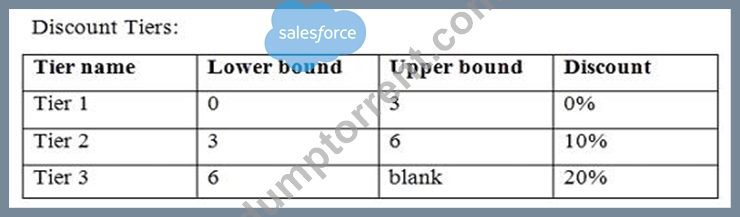
- A. $480.00
- B. $500.00
- C. $470.00
- D. $450.00
Answer: D
NEW QUESTION # 89
An Admin has set up option constraints in the Universal Container sandbox where Product A depends on the selection of Product B. During testing, it is determined that Product A can be selected regardless of whether Product B has been selected or not. Why is this happening?
- A. The Option Constraint was set up with type "Dependency."
- B. Product B was set up as the Constraining Option.
- C. The Option Constraint has not been activated.
- D. Product A was set up as the Constrained Option.
Answer: C
NEW QUESTION # 90
An Admin at Universal Containers wants to set up a product bundle that dynamically generates SKUs depending on what their users choose during the selling process. Which three fields are required for this type of configuration?
- A. Component Code Position
- B. Component Description Pattern
- C. Custom Configuration Page
- D. Configured Code Pattern
- E. Component Code
Answer: A,D,E
NEW QUESTION # 91
Given a customer's tiered pricing model, an Admin wants to allow users to define Discount Tiers and use those values as the Regular Price instead of an Amount deducted from the List Price.
How should the Admin configure the Discount Schedule to meet this requirement?
- A. Set the Discount Unit to Amount, create a custom Override_Amount_c field on the Edit Tiers page, select the User Defined checkbox, and then choose All from the Override Behavior picklist.
- B. Set the Discount Unit to Percent, set the Aggregation Scope to Quote, choose Current Tier from the Override Behavior picklist, and then select the User Defined checkbox.
- C. Set the Discount Unit to Percent, set the Aggregation Scope to Quote, choose Current Tier from the Override Behavior picklist, and then select the Use Price for Amount checkbox.
- D. Set the Discount Unit to Amount, choose All from the Override Behavior picklist, and then select the Use Price for Amount checkbox.
Answer: A
NEW QUESTION # 92
The Admin wants to ensure that within one bundle. Products A and B cannot both be added to the quote. During Configuration, the user should be able to freely switch between these options. If a user selects both, the system should only add Product A to the quote rather than product B. Which setup should the Admin use to meet these requirements?
- A. A Product Selection Rule where the Product Action with the lower Order removes Product A when Product B is chosen, and the Product Action with the higher Order removes Product B when Product A is chosen.
- B. A Product Alert Rule where two Error Conditions with Summary Variable test of Product A and B have both been selected. If so, a message will display, instructing the user to remove Product B.
- C. A Product Selection Rule where two Error conditions with Summary Variables test of Product A and B have both been selected. If so, a Product Action will remove Product B.
- D. Product Validation Rule where two Error Conditions with Summary Variables test if Product A and B are both selected. If so, a message will display, instructing the user to remove Product B.
Answer: C
NEW QUESTION # 93
Universal Containers requires that all users add at least one Product Option from the Maintenance Feature to a bundle. Additionally, users must select at least one and no more than two Product Options from the Support Feature.
How should the Admin set up these requirements for the users?
- A. Set Min Options and Max Options to zero for Maintenance. Set Min Options to zero and Max Options to two for Support.
- B. Set Max Options for Maintenance to one. Set Min Options to one and Max Options to two for Support.
- C. Set Min Options for Maintenance to one. Set Min Options to zero and Max Options to two for Support.
- D. Set Min Options for Maintenance to one. Set Min Options to one and Max Options to two for Support.
Answer: D
NEW QUESTION # 94
Universal Containers offers a bundle with two Products, Product A should always be added. Product B should be included initially, but can be removed by the user.
What two Option configurations that must be utilized for Product B to meet the requirement?
- A. Set Required to FALSE.
- B. Set Selected to TRUE.
- C. Set Bundle to FALSE.
- D. Set Quantity Editable to TRUE.
Answer: A,B
NEW QUESTION # 95
The Admin at Universal Containers (UC) has created one bundle that contains all of its products as Options.
The bundle has Subscription Pricing and Asset Conversion set to null on its Product record. Implementing the Product Catalog via a bundle allows UC to enforce logicabout which Products can be sold together. A bundle sold by UC contains a combination of Assets and Subscriptions.
After making selections within the bundle, a sales user saves the Quote and creates a Contract from the Opportunity associated with the primary Quote. Later, the sales user needs to amend this Contract based on new requirements from the customer. When UC amends the Contract using the Amend button, the sales user notices that the bundle is excluded in the Amendment Quote.
Why is bundle excludedin the Amendment Quote?
- A. The sales user must use the Amend Assets field on the Account to amend a Contract which contains Assets.
- B. The sales user neglected to select the Preserve Bundle structure field on the Contract.
- C. The bundled Product is excluded from the amendment because it lacks an Asset or a Subscription.
- D. By default, bundled Assets and Subscriptions are excluded in Amendment Quotes.
Answer: D
NEW QUESTION # 96
The admin decides to use a Price Rule to set a default 10% discount on Product A if a client has already purchased this item. Product A is an Asset product.
The admin has already created Price Conditions to target Quote Lines for Product A and the appropriate Actions to apply the 10% discount.
Which Summary Variable and Price Condition are needed to apply this Price Rule to Quote Lines for Product A. the item the customer purchased previously'
- A. Create a Summary Variable counting the Asset records for Product A and create a Price Condition verifying that the Quantity field on the Quote Line is greater than the Summary Variable.
- B. Create a Summary Variable summing the Quantity field of Product A from Quote Lines and create a Price Condition verifying that the Summary Variable is greater than the value 1.
- C. Create a Summary Variable counting the Asset records for Product A and create a Price Condition with the Tested Field value set to Quantity and the Tested Object value set to Asset is greater than the value
0. - D. Create a Summary Variable summing the Quantity field on Asset records for Product A and create a Price Condition verifying that the Summary Variable is greater than the value 0.
Answer: D
Explanation:
Requirement:
* Apply a 10% discount to Product A on the Quote Line if the customer has previously purchased Product A (stored as an Asset).
Solution:
* Summary Variable:
* Sum the Quantity field on Asset records for Product A.
* Price Condition:
* Verify that the Summary Variable is greater than 0 to confirm the customer has purchased Product A.
Why Other Options are Incorrect:
* B: Quote Lines do not track prior purchases; Assets do.
* C, D: These do not align with the requirement to verify prior purchases via Assets.
Salesforce CPQ Reference:
* Summary Variables and their use in Price Rules are documented under CPQ Discounting Guidelines .
NEW QUESTION # 97
Universal Containers sells a container management bundle with Product Options representing different service levels. The admin has created a Configuration Attribute for the bundle to let users specify the service level while in the Quote Line Editor.
Which two actions should the admin take to limit the options in the bundle that are displayed to the user when a service level is selected?
Choose 2 answers
- A. Ensure Apply Immediately is set to TRUE on the Configuration Attribute.
- B. Create a Selection Product Rule that automatically shows and hides Product Options based on the service level
- C. Ensure Apply to Product Options is set to TRUE on the Configuration Attribute.
- D. Create a Selection Price Rule that automatically shows and hides Product Options based on the service level.
Answer: A,D
Explanation:
Requirement Overview:
* Limit the Product Options displayed in a bundle based on the service level selected by the user via a Configuration Attribute.
Solution Details:
* Selection Price Rule: Use a Selection Price Rule to dynamically show or hide Product Options based on the selected value of the Configuration Attribute.
* Apply Immediately: Ensures that changes based on the service level selection occur in real-time during configuration.
Steps to Configure:
* Create the Selection Price Rule:
* Define the Price Rule with a Condition targeting the Configuration Attribute value.
* Use a Price Action to show or hide Product Options.
* Set Apply Immediately:
* Navigate to the Configuration Attribute.
* Set Apply Immediately to TRUE.
Validation:
* Test the bundle configuration by changing the service level and verifying the Product Options displayed dynamically update.
NEW QUESTION # 98
When creating Orders from Quotes with Salesforce CPQ, the Admin wants to separate similar Products into Orders based on the Product Family of the Products being ordered.
Which two steps must the Admin perform to automatically split these types of Orders? Choose 2 answers
- A. Enable Allow Multiple Orders from a checkbox in the CPQ Package Settings.
- B. Set the Order By field on the Quote to Product Family.
- C. Enable Allow Multiple Orders from a checkbox on the Quote.
- D. Set the Order By field on the Quote Line to Product Family.
Answer: B,C
NEW QUESTION # 99
Universal Containers has a block priced product, Cloud Contacts, and wants to apply a 10% premium to the product when the payment frequency is annual. Based on the Price Actions below, what is the correct Order for the actions?
a) SBQQ__CustomerPrice__c = SBQQ__RegularPrice__c * (1 - SBQQ__ Discount_c) b) SBQQ__NetPrice__c = SBQQ__PartnerPrice__c * (1 - SBQQ__ DistributorDiscount_c)
* SBQQ__PartnerPrice__c = CustomerPrice__c * (1 - SBQQ__ PartnerDiscount_c) d) SBQQ__RegularPrice__c = SBQQ__ListPrice__C * 1.1
- A. b) c) a) d)
- B. a) b) c) d)
- C. d) a) c) b)
- D. d) c) a) b)
Answer: C
NEW QUESTION # 100
......
Real Salesforce CPQ-Specialist Exam Questions Study Guide: https://pass4sure.dumptorrent.com/CPQ-Specialist-braindumps-torrent.html